Muhammad Ahsan Khan, a 90-year-old scholar from Lahore and a respected authority on Urdu language and lexicography, recently raised serious concerns about the glossaries included in Federal Board Urdu textbooks. Known for his passion for accurate language use, Ahsan Khan often contacts me whenever he notices incorrect explanations or misused words in Urdu texts.
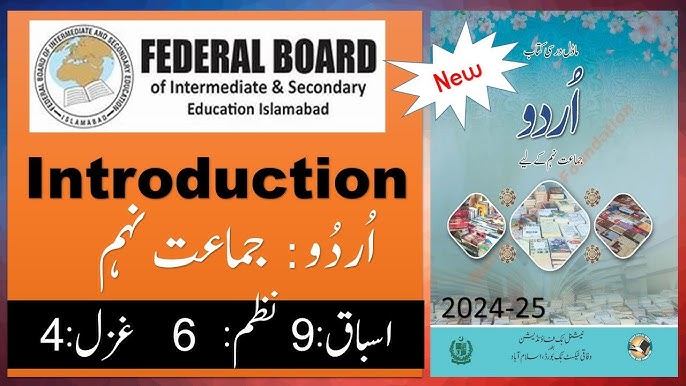
Last week, visibly upset, he told me that even government-approved Urdu textbooks now contain numerous language errors. He urged me to review the textbooks published by the Federal Textbook Board in collaboration with the National Book Foundation.
Following his advice, I examined the Urdu textbooks for Classes IX through XII. All were marked as approved by the Ministry of Federal Education and Professional Training and the National Curriculum Council Secretariat.
Let’s take a closer look at some of the glossary entries that illustrate the problem:
In the Class XI book Model Darsi Kitab, the word “pesh khaima” is defined as “result, something that happens before an action is taken.” This definition is logically flawed—how can a result occur before the action?
The idiom “tees maar khani dikhana” is listed without a proper explanation; it simply repeats the phrase as its meaning, showing no effort in editing.
“Dastak” is defined as “to knock on the door,” when it actually means “a knock” (a noun). The compilers confused the noun with a verb.
The phrase “laa ubaali tabiyet” is defined as “passionate temperament.” Not only is the gender of the word “tabiyet” mishandled (it’s feminine, yet “vala” is used instead of “vali”), but the meaning is completely incorrect. The correct definition is “a careless or indifferent attitude.”
In the Class X book, the word “khalish” is wrongly explained as “a desire that remains unfulfilled.” In reality, it means “a persistent discomfort or emotional prick.”
“Safed posh” is said to mean “someone dressed in white,” whereas it is a metaphor for a person of modest means who maintains dignity and self-respect.
The Class IX glossary defines “maoof hona” as “capable of thinking,” likely because the word “na hona” was mistakenly omitted, reversing its meaning.
Words like “bhatti” are incorrectly spelled as “bathi”, and several entries are provided in plural or oblique form, which goes against standard lexicographic practice.
Moreover, glossaries should include signs such as tashdeed and izaafat to guide pronunciation, yet they are missing entirely, making it difficult for students to read correctly.
Even names are misspelled—Zahra Nigah appears as “Zahra Niga” in the contents and “Zahra Nigar” in the glossary.
Surprisingly, some of these books are labeled “Test Edition,” yet more than 100,000 copies have been printed and distributed. This raises the alarming question: are government school textbooks being issued without proper review and sold as experiments?
It is urgent that the Federal Board consult experienced lexicographers like Ahsan Khan or Saleemur Rahman to correct these errors. Students deserve accurate, reliable educational material.