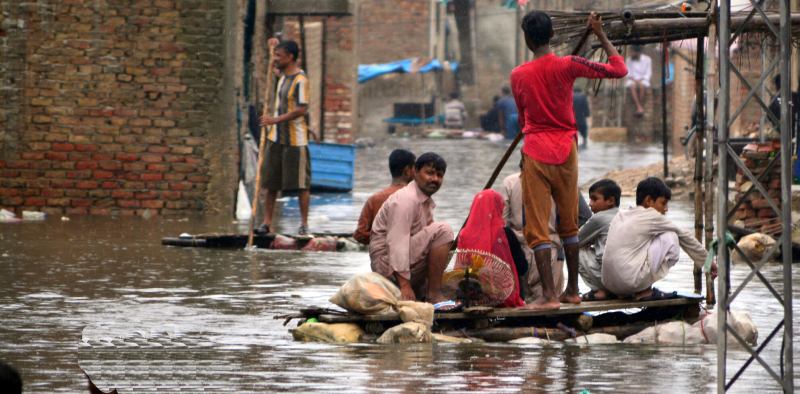
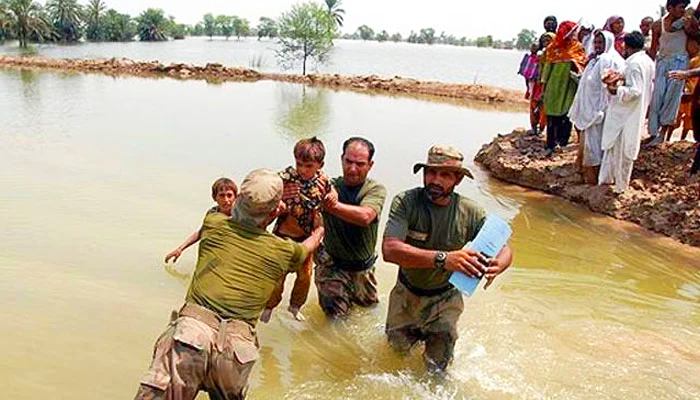
Since June 4, 2025, cloudbursts and flash floods have pummeled Pakistan’s northern arc—Gilgit-Baltistan, Azad Jammu & Kashmir, and KP districts like Swat and Buner—leaving hundreds dead and communities cut off. From the field, this is what I saw and what the land is telling us.
In early June, the high country changed tone. What locals first called an aberration soon proved a pattern: short, furious cloudbursts collapsing into narrow valleys, feeding flash floods that tore out bridges and bit straight through towns. Kalam in Swat turned to a slurry of boulders and mud; Buner’s access roads simply ceased to exist; Hunza and Ghizer, long sold as postcards, read like ledgers of loss. A month’s rain, falling in under an hour, outran both the mountains’ natural drainage and the concrete channels humans had pressed onto the slopes.
What turned rain into ruin
Across Swat and Buner, deforestation has traded root-bound soils for bare, erodible faces. Without vegetation, rain no longer infiltrates quietly; it sprints downslope, carving fresh gullies, loading streams with sediment, and destabilizing valley walls. In the steep catchments of GB, including Diamer, hillsides slumped into rivers and forced channels to change course, exporting risk downstream.
Development choices amplified the hazard. Real-estate projects—often unregulated—rose along riverbanks, on alluvial fans, and across floodplains. In Muzaffarabad and Mingora, “reclaimed” colonies suffered most because the land was never reclaimed; it was borrowed from the river and the river came to collect.
Hardscape worsened the odds. Concrete replaced sponge-like soils, turning stormwater into a fast, shallow weapon. In Buner, unregulated limestone quarrying weakened rain-stressed slopes. The Karakoram Highway, the region’s lifeline, was blocked again and again by landslides born of the very erosion our choices accelerate.
A warning we already had
Pakistan has seen this movie. In January 2010, the Attabad landslide dammed the Hunza River, creating a 21-kilometer lake more than 100 meters deep. It drowned villages and long stretches of the highway, killed residents, displaced thousands, and stranded tens of thousands. The message was plain. Yet within years, portions of Attabad’s shores were commodified into resorts and farmhouses—some drawing allegations of untreated sewage slipping into ice-blue water. Turning a geologic admonition into an amenity says less about nature than it does about us.
The cost, counted and uncounted
Beyond lives lost, farmers in Buner saw whole harvests erased. Tourism-dependent communities across GB teetered. Schools, clinics, and bazaars lay in ruins. The psychological costs—grief, displacement, groundlessness—resist tallying. Along the Swat River, where repeated warnings should have settled the matter, commercial blocks again hugged the edge, only to be swept away when the river reclaimed its right-of-way.
The pattern doesn’t stop at a border. Himachal Pradesh, Uttarakhand, and Kashmir on the Indian side are following the same script: extreme, short-duration rain stalls over steep catchments; torrents race along ancient channels; settlements on fans and floodplains are scoured and, in places, turned back into riverbeds.
How Himalayan rivers “remember”
Understanding this memory is survival. In quiet years, channels sit within embankments; in wet years, they jump to paleochannels, surge across fans, undercut roads, and tear at bridge abutments. Fans are not stable terraces but archives of violent flows, destined to be rewritten. Add warmer, moister air, melt pulses, bare slopes, and hardscaped towns, and sudden, landscape-scale rearrangements become expected rather than exceptional.
Living with the mountains, not against them
Policy must match the land’s logic—starting at the ridge and working down:
- Regenerate cover: Restore native vegetation, halt illegal cuts, and deploy bioengineering to pin soils and rebuild the mountains’ sponge function.
- Redraw where we build: Enforce no-build and managed-retreat zones on floodplains, fans, and river setbacks; create riparian buffers that exist beyond maps; halt riverbank hotels and plazas in high-hazard corridors.
- Regulate extraction: Curb or stop quarrying where slopes cannot be stabilized.
- Move or elevate infrastructure: Relocate out of scour zones; where relocation is impossible, design for failure modes—assume slope and bridge loss—not perpetual stability.
Warn early, act locally
Early warning has to be hyperlocal and fast: valley-scale rain and stream gauges, sirens, and cell-broadcast alerts that trigger when thresholds are crossed. Build a modern hazard atlas for GB, AJK, and KP using remote sensing, historic flood imprints, and geomorphic mapping to delineate paleochannels, debris-flow paths, and fan extents—and then treat those lines as hard constraints for settlement and investment.
Mountain towns also need sponge-city tools adapted to altitude. And community preparedness should be budgeted like infrastructure: mapped evacuations, drills, and local brigades equipped for first response.
The lesson written in water and stone
We cannot pretend every scenic bank or fan is a developable plot, or that yesterday’s benign stream will not be tomorrow’s river. These disasters are political and ecological outcomes—products of incentives to build where land is cheap and views are grand, of weak enforcement, and of short-term economics over long-term safety.
The floods of 2025 are a wake-up call. If the geographies of GB and KP are changing, then policies and priorities must change with them. Resilience is not only rebuilding walls after they fall; it is redrawing our maps to respect the land’s memory—and learning to live with the mountains on their terms, not ours.